Speed Key Name: | (pipe character)
Signals
Digital inputs: <i1> through <i999>
One digital output: <out>
Description
The OR symbol drives its output signal high if any one or more of the inputs are high. If all the inputs are low, the output is low.
The OR symbol can be expressed using a truth table, where low stands for logical 0 (false), and high stands for logical 1 (true). Thus the truth table has <out> = high for the rows where <i1> = high, <i2> = high, or both are high.
Truth table for two-input OR:
|
<i1> <i2> |
<out> |
|
low low |
low |
|
low high |
high |
|
high low |
high |
|
high high |
high |
Note from the truth table that when both of the input signals are high, the output is still high. If you need an operation where the output is high when only one of the inputs are high; you can use an Exclusive OR (XOR) symbol.
Note that the OR symbol has an arbitrary number of inputs (determined by the specific application), and a single output. That is, a 20-input OR symbol will have a high output whenever any of the 20 input signals are high.
Example: Volume Un-mute
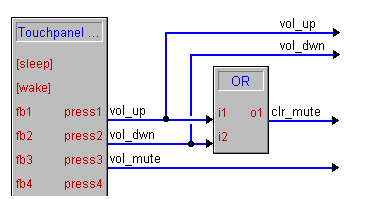
Volume control typically consists of up, down, and mute buttons. When the audio has been muted, you may want to un-mute it automatically if the volume up or down buttons were pressed. To accomplish this you could use an OR symbol like the one shown. (Additional logic is needed to finish this example.)
See also NOR